· By Nicholas “Nick” O'Sullivan, Townsville
Queensland's $11.5 million micro-credentials program: free cyber security, AI and procurement training for small business

A $11.5 million Queensland Government investment is now funding free cyber security, AI and procurement training for small and family businesses, delivered through the University of the Sunshine Coast (UniSC) — and a separate, already-open free cyber security course runs through TAFE Queensland. Both are worth flagging to any small business, charity or church we work with, because “free and genuinely useful” is a rarer combination than it sounds, and this is one of the few cases where it holds up on closer inspection.
What was actually announced. On 29 July 2026, the Crisafulli Government’s Minister for Small and Family Business, Steve Minnikin, and Member for Buderim Brent Mickelberg jointly announced an expanded $11.5 million investment in free micro-credential courses, delivered by UniSC. Six new courses are being added by 2029, forming part of the government’s Small and Family Business First Action Statement — an election commitment, not a one-off grant round. UniSC’s Vice-Chancellor, Professor Helen Bartlett, described the goal as “flexible, industry-relevant micro-credentials that support the real needs of small and family businesses,” delivered face-to-face, online and in hybrid formats.
What’s open for enrolment now. Three UniSC micro-credentials are already available to Queensland-based small and family businesses, all free:
- Business Planning — 2 hours a week for 6 weeks, developing a working business plan using strategic management principles.
- Continuity Planning — building a business continuity plan and improving organisational resilience.
- Workforce Planning for Business — a 7-week course focused on productivity and operational efficiency.
Registrations for 2026 intakes are opening soon, and can be lodged through UniSC’s business planning course page, by phone on (07) 5430 2925, or by email to [email protected].
What’s coming — AI, cyber security and procurement. The three courses of most direct interest here — artificial intelligence, cyber security and procurement — are still in development, with an expected early-2027 launch. UniSC is taking expressions of interest now through its business micro-credentials EOI page, which is worth doing even this far ahead, since it’s currently the only way to be notified the moment enrolments actually open.
A second, separate free course you don’t have to wait for. Outside the UniSC program entirely, TAFE Queensland already runs a free, stand-alone cyber security micro-credential through the Queensland Future Skills Partnership — a separate initiative led by BHP Mitsubishi Alliance with TAFE Queensland and CQUniversity as education partners, funded through investment from the Queensland Resources Industry Development Plan. It’s a short, blended course — roughly 6 to 8 hours in total, combining a self-paced online module, a practical activity, and a facilitated webinar or workshop — introducing current and emerging cyber security trends, the threats that matter and their business impact, the Australian legislation and frameworks that apply, and how to support cyber security efforts across a workplace, from asset management through to governance and legal. Expressions of interest are particularly encouraged from workers in regional locations, which covers Townsville and the rest of North Queensland squarely.
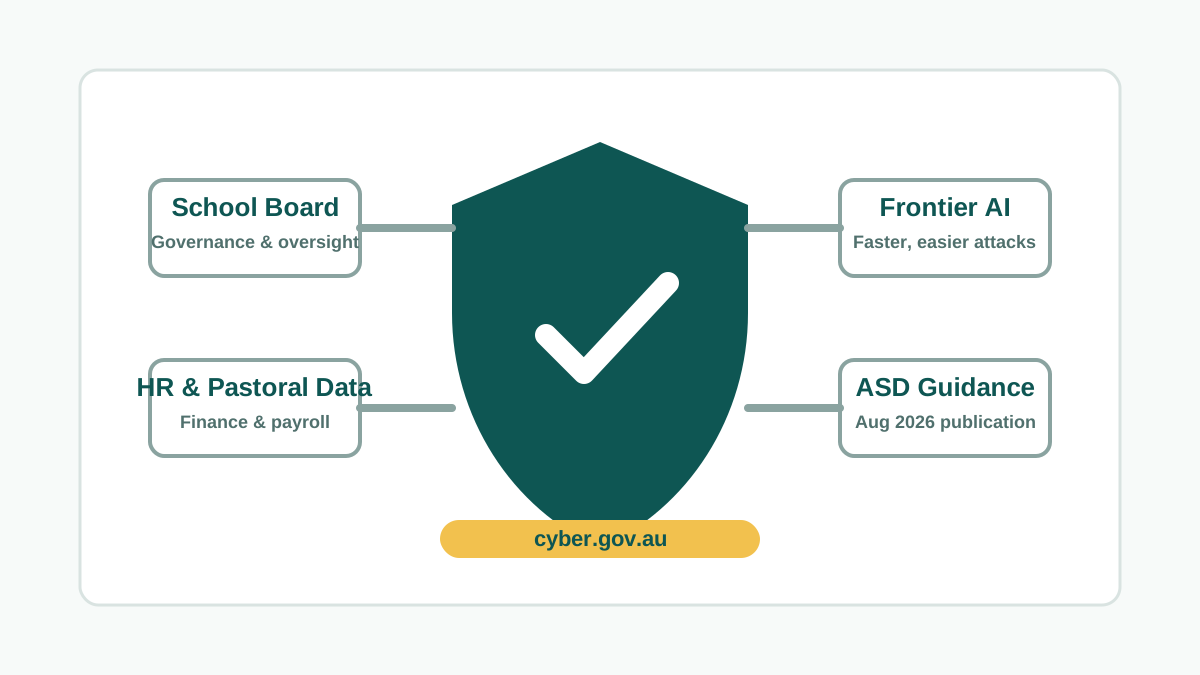
Why this is worth a board or leadership team’s time, not just a training tick-box. We’ve written before about the frameworks that sit above individual businesses — what the ASD and ACSC actually do, and Australia’s Cyber Security Strategy and its six shields — and one of those shields is specifically about lifting the baseline cyber security literacy of small and family businesses, since they make up the overwhelming majority of Australian enterprises and rarely have a dedicated security function of their own. A free, government-backed micro-credential is a genuinely low-friction way to close part of that gap without committing a training budget you don’t have.
What free training does and doesn’t replace. A micro-credential builds knowledge — it won’t tell you whether your business’s own email authentication, admin accounts, backups or network are actually configured properly today. That’s a different question, and it’s the one a Leadership Technology Review is built to answer. If you’d like an honest, plain-English read on where your organisation actually stands before or after doing any of this training, start with our free cyber security check for an instant snapshot, or get in touch to talk through a proper review.